Protecting Against Zero Day SAP Vulnerabilities: CVE-2025-31324 & CVE-2025-42999

New Intelligence to Protect SAP from Ransomware and Data Breaches
Woman sitting at a computer surrounded by abstract representations of programming and technology

CVE-2025-31324

Emergency Patch Issued

On April 24, 2025, SAP released an emergency patch for a CVSS 10.0 zero-day vulnerability that affects SAP Visual Composer, an optional but broadly installed component present in 50-70% of SAP Java systems worldwide.

CVE-2025-31324

Confirmed Active Exploitation

This vulnerability is actively being exploited in the wild, as noted by Onapsis Threat Intelligence and multiple IR firms and security researchers. It was first publicly reported by ReliaQuest.

CVE-2025-42999

Exploited in Tandem

Onapsis Research Labs found CVE-2025-31324 is often used with CVE-2025-42999 (insecure deserialization in SAP Visual Composer) for unauthenticated remote code execution. SAP addressed this with Security Note 3604119 (May 13, 2025). Applying both patches is crucial.

CVE-2025-42999

Chained Exploitation Enables Unauthenticated RCE

CVE-2025-42999 becomes far more dangerous when combined with CVE-2025-31324, enabling attackers to upload and execute malicious payloads without authentication. This chaining method has been observed in real-world attacks and leads to full remote code execution.

Woman working at a computer

Read our resource page to learn more about the threat and potential business impact of this critical zero-day vulnerability as well as get recommendations and tools to help you mitigate:

  • Details about the CVE-2025-31324 and CVE-2025-42999 vulnerabilities.
  • Reporting on active exploitation in the wild and observations from Onapsis Research Labs.
  • How to determine if you’ve been exploited.
  • Recommendations on how to patch or mitigate this vulnerability in your essential SAP systems.
  • Get access to an open-source scanning tools and a YARA rule from Onapsis Research Labs.

Unpacking CVE-2025-31324 and CVE-2025-42999

CVE-2025-31324 is a critical zero-day vulnerability in the SAP NetWeaver Visual Composer component, rated CVSS 10.0. Actively exploited in the wild, this flaw allows unauthenticated remote code execution (RCE) and poses an immediate risk to vulnerable SAP Java systems. In many observed attacks, it is chained with CVE-2025-42999, a related deserialization vulnerability, to enable full system compromise without prior access.

Affected Component

The vulnerabilities reside in the developmentserver/metadatauploader endpoint within SAP Visual Composer (NetWeaver 7.x). Although not installed by default, Visual Composer is enabled in approximately 50–70% of SAP Java systems due to its historical use in no-code business application development. Both CVE-2025-31324 and CVE-2025-42999 exploit this component—one enabling unauthenticated file uploads, the other leveraging insecure deserialization for code execution.

Exploitation Method

Threat actors exploit this issue by sending unauthenticated HTTP POST requests to the vulnerable endpoint, enabling arbitrary file uploads—typically web shells such as helper.jsp or cache.jsp. In observed attack chains, the uploaded payload often contains serialized objects that trigger CVE-2025-42999 upon deserialization, allowing code execution. Successful exploitation results in full system compromise with adm privileges.

Detection and Indicators of Compromise

Systems compromised via CVE-2025-31324 often contain suspicious .jsp, .class, or .java files in the following directories:

  • /irj/root/
  • /irj/work/
  • /irj/work/sync/

In attack chains involving CVE-2025-42999, look for evidence of serialized Java objects or deserialization-related payloads embedded in uploaded files. Refer to SAP Note 3596125 for detailed guidance on identifying indicators of compromise.

Mitigation and Patch Guidance

  • Apply the emergency patch from SAP Security Note 3594142 to remediate CVE-2025-31324
  • Apply SAP Security Note 3604119, released May 13, 2025, to address CVE-2025-42999
  • If patching is not immediately possible, follow the mitigation steps in SAP Note 3593336
  • Review the full technical recap on how to remediate SAP zero-day CVE-2025-31324 to understand the exploit mechanics and hunt for indicators of compromise.
  • Onapsis Assess enables identification of unpatched systems across your SAP landscape
  • Onapsis Defend detects and alerts on malicious POST activity targeting SAP Visual Composer

Why Onapsis Research Labs?

Onapsis Research Labs was the first to observe reconnaissance activity related to CVE-2025-31324 in January 2025, weeks before the vulnerability was officially identified. Our team has since:

  • Identified and documented active exploitation across customer environments
  • Coordinated directly with SAP and incident response teams
  • Released an open-source IOC scanner in partnership with Mandiant
  • Provided comprehensive threat intelligence briefings and mitigation guidance to the SAP security community

As the most experienced SAP cybersecurity research team in the world, Onapsis continues to lead with real-time detection, rapid response, and actionable insights. See below for additional SAP security information and recourses regarding CVE-2025-31324:
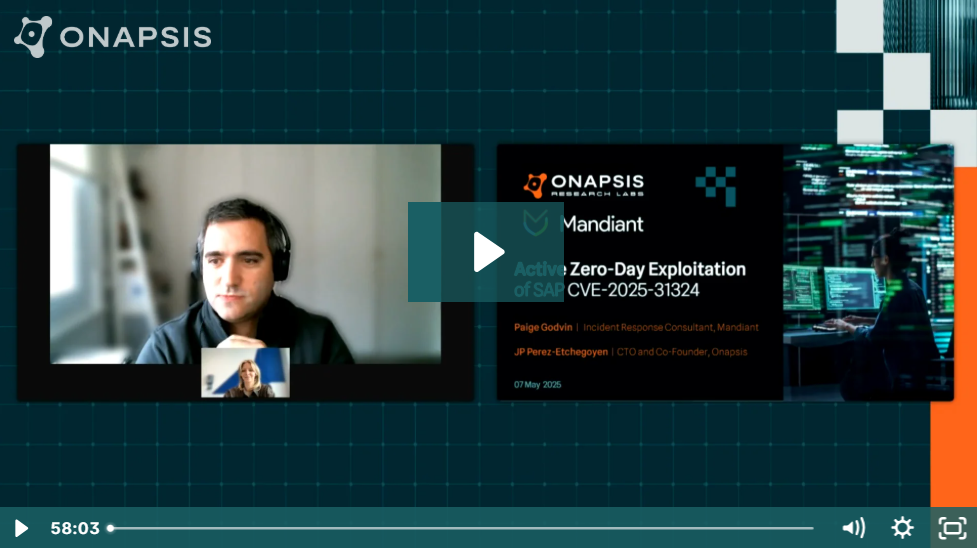
ON DEMAND WEBINAR

Onapsis and Mandiant: Latest Intelligence on CVE-2025-31324

Critical SAP Zero-Day Vulnerability Under Active Exploitation

In this webinar with Mandiant you will hear direct insight from leading threat intelligence experts on the active SAP zero-day vulnerability (CVE-2025-31324), its real-world impact, and how your team can respond effectively.

Related Articles

Security Week Cybersecurity News, Insights & Analytics
Bleeping Computer
The Register
SAP Insider
ERP Today
Help Net Security

CVE-2025-31324 Frequently Asked Questions

Yes, SAP NetWeaver Java 7.0 with the Visual Composer Framework is highly vulnerable to CVE-2025-31324. SAP no longer supports this specific version of NetWeaver Java and will not issue security patches to address the vulnerability. Security teams must follow the workaround steps described in SAP Note 3593336 and formulate a plan to upgrade the system to a supported NetWeaver Java version.

Yes, non-internet-facing SAP environments remain vulnerable to CVE-2025-31324. Removing internet exposure only reduces the frequency of automated exploitation attempts. The vulnerability remains critical and requires immediate action. Threat actors utilize automated exploit tools and lateral movement techniques from within compromised networks to execute attacks. Ransomware operators frequently leverage internal network access to deploy malicious payloads.

All organizations and industries face high risk from CVE-2025-31324 exploitation. Threat activity monitored by Onapsis Research Labs indicates widespread, opportunistic exploitation over HTTP. While critical infrastructure sectors face severe risk, the fundamental nature of the vulnerability dictates that any organization running the affected component must apply mitigations immediately.

No, ransomware attacks targeting SAP systems are not limited to specific operating systems. Threat actors frequently target Windows-based operating systems due to established ransomware instrumentation. However, non-Windows environments hosting SAP systems remain highly susceptible to exploitation and subsequent ransomware deployment.

Security administrators must list the components of the SAP system and check for “VISUAL COMPOSER FRAMEWORK” or “VCFRAMEWORK”.

  • Prerequisites: Administrative access to the SAP NetWeaver Administrator (NWA) portal or an active Onapsis Assess license.
  • Step-by-Step Actions:
    1. Navigate to the SAP system component list.
    2. Search for the terms “VISUAL COMPOSER FRAMEWORK” or “VCFRAMEWORK”.
    3. If identified, immediately apply SAP Security Note 3594142.
    4. Alternatively, enact the mitigations in SAP Note 3593336 to restrict component reachability.
  • Verification: Run the open-source scanner released by Onapsis Research Labs, or utilize Onapsis Assess to programmatically verify system exposure across the SAP landscape.

SAP Solution Manager 7.2 is affected only if the Visual Composer Framework was included during the installation process. System administrators must review the Java components of the specific Java SID to confirm the presence of the “VISUAL COMPOSER FRAMEWORK” or “VCFRAMEWORK” component.

CVE-2025-31324 was discovered as a zero-day vulnerability during active, widespread exploitation in the wild. The vulnerability was not responsibly disclosed by a security researcher prior to exploitation. Threat actors actively utilized the flaw across global SAP applications before detection. DFIR services and Onapsis Research Labs observed ongoing exploitation across live environments.

Two men pair programming at a computer

Stay Ahead of Vulnerabilities with Onapsis Research Labs

Cybersecurity demands proactive measures, and protecting your SAP systems from the vulnerabilities being exploited is a critical endeavor. Don’t hesitate—reach out to us today to start strengthening your SAP environment’s security. Together, we can ensure your systems remain resilient and safeguarded against evolving threats.