
Days to Zero: How Ransomware and Accelerated Exploitation are Reshaping SAP Security
A research report brought to you by Onapsis & Recorded Future



123% Surge in Underground SAP Threat Discussions: Security-relevant SAP threat and vulnerability discussions in underground sources more than doubled between 2023 and 2025.
Explosion in Threat Actors Targeting SAP with Ransomware: The number of active ransomware and extortion groups targeting SAP environments expanded dramatically from a single actor in 2022 to over 20 groups in 2026.
Collapsed Time-to-Exploit SAP Applications: The window between an SAP Security Note release and verified public exploitation or proof-of-concept dropped to just 1–3 days.
THREAT REPORT
Days to Zero: How Ransomware and Accelerated Exploitation are Reshaping SAP Security
Onapsis and Recorded Future have joined forces for a collaboration to illuminate SAP applications. This report covers:
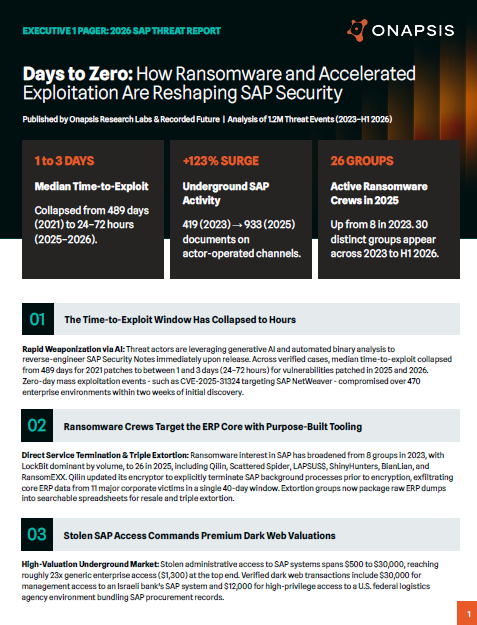
- +123% growth in SAP-relevant activity on actor-operated underground channels (2023→2025), from 419 to 933 distinct documents.
- 26 distinct ransomware and extortion groups appeared in SAP-relevant content in 2025, up from 8 in 2023. Across the full 2023 to H1 2026 window, 30 different groups appear at least once.
- 1 to 3 days median time from SAP Security Note release to first verified public exploitation or proof-of-concept for vulnerabilities patched between 2025 and 2026, down from 489 days for those patched in 2021.
Short on time?
Skip the report and dive straight into the key takeaways with our Executive 1-Pager. Designed for busy security and IT leaders, this concise summary delivers the critical data, emerging threats, and actionable insights from the 2026 SAP Threat Report, giving you everything you need to know in a fraction of the time.
Frequently Asked Questions

Stay Ahead of Accelerated SAP Exploits with Onapsis
The “Days to Zero” report proves that adversaries are targeting SAP faster than ever. Don’t leave your business-critical applications exposed to ransomware syndicates and zero-day attacks. Contact our experts today to shift to continuous SAP exposure management and lock down your landscape before the next exploit drops.